
Back & neck pain care
Spinal Decompression Therapy
Non-surgical, drug-free relief for back and neck pain from bulging or herniated discs, sciatica and pinched nerves. Gentle, computer-guided treatment on the Hill DT decompression table at our Port Neches clinic.
Call 409.210.3336 to book.
What the research shows
Results from randomized clinical trials
Both are small randomized trials of patients with lumbar disc problems. Other trials found decompression worked about as well as conventional traction, and reviews describe the overall evidence as limited, so results vary from person to person. We'll tell you honestly whether we think it's a good fit for you.
The basics
What is spinal decompression?
When a bulging or herniated disc presses on a nerve, the pain can travel well beyond your spine: down a leg, or into a shoulder and arm.
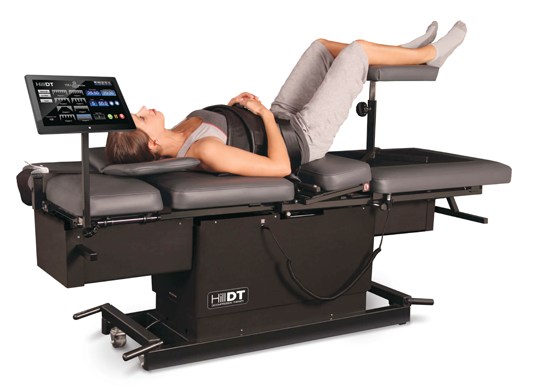
Non-surgical spinal decompression is a gentle, computer-controlled stretch of the spine. You lie comfortably on a padded table while it slowly pulls, holds and releases in cycles, taking pressure off the discs and joints between your vertebrae. There are no needles, no medication and no incisions, and you stay fully clothed.
We use the Hill DT, an FDA-cleared decompression table made by Hill Laboratories in Pennsylvania. It treats both the low back and the neck.
How can stretching the spine help?
Your spinal discs are cushions with a tough outer ring and a gel-like center. With wear or injury, that center can bulge or push through the ring and press on nearby nerves. Discs also have very little blood supply, so they heal slowly.
When the spine is gently stretched and relaxed in cycles, pressure inside the disc drops. One study measured pressure inside the disc falling below −100 mmHg during decompression. That lower pressure is thought to help draw bulging material back toward the center of the disc and let water, oxygen and nutrients move in to support healing.
In a 2022 randomized trial, follow-up MRI scans showed herniated discs shrank more after decompression than after a sham treatment.
Benefits of spinal decompression
A conservative option that works with your body, without surgery or medication.
Non-surgical
No incisions, anesthesia or hospital stay. A conservative step to try before considering surgery.
Drug-free
Relief that doesn't depend on pain pills or injections.
Gentle and comfortable
Sensors track your body's response and ease the pull before your muscles tense up.
Targets the problem disc
The table angle is set to focus the stretch on the level that's causing your symptoms.
Low back and neck
Lumbar treatment for back and leg pain, cervical treatment for neck and arm pain.
You stay in control
You hold a stop switch the whole time. Press it and the table gently releases.
Common conditions
What we treat with decompression
The Hill DT is used for back and neck pain associated with:
- Bulging discs
- Herniated or ruptured discs
- Sciatica & radiating leg pain
- Degenerative disc disease
- Pinched nerves (radiculopathy)
- Facet syndrome
- Spinal stenosis
- Spinal arthritis
- Chronic low back pain
- Low back strain & sprain
- Neck pain & arm pain from neck discs
- Not sure? Ask us about your condition.
Who should not have spinal decompression
For your safety, decompression isn't used if any of the following apply. We screen for these at your consultation.
- Pregnancy
- Under 18 years old
- Osteoporosis
- Vertebral fracture
- Spondylolysis or spondylolisthesis
- Spinal fusion, artificial discs or other spinal hardware
- Spinal tumor or cancer that has spread
- Abdominal aortic aneurysm
- Some congenital spine abnormalities
- Body weight above the table's limit
How it works
What makes the Hill DT different?
Older traction tables pull with one steady force, and the body tends to fight back: the muscles around the spine tighten up, which is called guarding. That can limit how much the discs actually benefit.
The Hill DT is built to avoid that. Its sensors take more than 10,000 readings for every millimeter of movement and ease off as your body nears its comfort threshold. The table then cycles between a gentle pull and a partial release, so your muscles stay relaxed while the discs are decompressed.
Your provider chooses from eight treatment programs and sets the force and angle for you. The table saves your settings, so each visit picks up where the last one left off.
Cycles, not a constant pull
The table pulls, holds and partially releases in timed cycles, giving your muscles a chance to relax between stretches.
Sensors that prevent guarding
Load sensors read the pull continuously and back off before your body tenses, for a smooth, low-force treatment.
Angle targets the disc
The table tilts up to 25° for the low back and 15° for the neck. Lower angles focus on the lowest discs; higher angles reach discs further up.
Gentle force range
Low-back treatment ranges from 5 to 100 lb and neck treatment from 5 to 35 lb. Your provider starts low and adjusts as you go.
Neck cradle
For cervical treatment, a padded cradle supports the base of your skull and can tilt to take pressure off the back of the disc.
Built-in safety
A patient stop switch and a quick-release strap mean you can end treatment at any time; the table slowly returns to its starting position.
Your visit
What a treatment looks like
Consultation & exam
We review your history, symptoms and any imaging, and screen for anything that would make decompression unsafe.
Get comfortable
You lie on your back, fully clothed. For the low back, a harness fits around your lower ribs and hips and your calves rest on a cushion. For the neck, a padded cradle supports your head.
Relax for about 30 minutes
The table gently pulls and releases. You'll feel a stretch, not pain, and you hold the stop switch the whole time.
Head back to your day
There's no downtime. We may pair sessions with heat, MLS laser or simple core exercises to support your results.
Your treatment course
Each dot is one session. Every plan starts at a minimum of 20 to 24.
Your provider may recommend more sessions depending on your condition and how you respond. Many patients don't notice much change for the first several sessions, and improvement often shows up around weeks 3 to 4, so finishing the full course matters.
Success stories
What patients and doctors say
Shared by Hill Laboratories, the maker of the Hill DT. These are not gerstenberg.clinic patients, and individual results vary.
“After 24 treatments, I am no longer in pain and am back to work.”
“We are seeing dramatic improvement in disc herniation cases, including some that I thought would need surgery.”
“Patients are consistently getting better and love the fact that the treatment is natural and drug free.”
Video: Hill DT Spinal Decompression: Patient Stories, from Hill Laboratories.
Is back or neck pain holding you back?
If disc pain, sciatica or a pinched nerve is limiting your day, schedule a consultation. Your provider will examine you, review your history and any imaging, and tell you honestly whether decompression is a good fit.
FAQ
Frequently asked questions
Don't see your question? Call us and we'll walk you through it.
Call 409.210.3336What is non-surgical spinal decompression?
It's a gentle, motorized stretch of the spine done on a specialized table. The table slowly pulls, holds and releases in cycles to take pressure off the discs and joints in your low back or neck. It's done without surgery, needles or medication.
How is decompression different from traction or an inversion table?
Traditional traction applies one steady pull, and inversion tables use gravity by tipping you upside down. A decompression table like the Hill DT is computer-controlled: it pulls, holds and partially releases in cycles, and its sensors ease off before your muscles tense.
To be straightforward, some studies found results similar to conventional motorized traction. We see decompression as a comfortable, precisely controlled way to deliver this kind of care, not a miracle cure. Inversion tables also carry risks for people with high blood pressure, heart disease, glaucoma or pregnancy.
Does spinal decompression hurt?
It shouldn't. You'll feel a gentle stretch in your back or neck, and many patients find it relaxing. Some soreness afterward is possible. Tell us right away if anything feels painful, and remember you can stop the table at any time with the switch in your hand.
What happens during a session?
You lie on your back, fully clothed. For low-back treatment, a harness fits around your lower ribs and hips and your calves rest on a padded support, which flattens your lower back. For neck treatment, a padded cradle supports your head. The table then runs your program while you rest.
How long is each session?
About 30 minutes on the table. Plan a little extra time if we add heat, laser or exercises to your visit.
How many sessions will I need?
Our treatment plans start at a minimum of 20 to 24 sessions. Your provider may recommend more based on your condition and how you respond, and will go over your plan at your consultation.
When will I notice results?
Decompression usually works gradually. Many patients don't notice much change for the first several sessions, and improvement often shows up around weeks 3 to 4. That's why completing the full course matters.
Am I a good candidate?
Decompression is used for back or neck pain from disc problems and irritated nerves, such as bulging or herniated discs, sciatica, degenerative disc disease and pinched nerves. It's often a good fit if rest, medication or physical therapy haven't given you enough relief and you want to avoid or delay surgery. We'll examine you and review any imaging to decide together.
Who should not have spinal decompression?
It isn't used during pregnancy, for anyone under 18, or for people with osteoporosis, a vertebral fracture, spondylolysis or spondylolisthesis, spinal fusion, artificial discs or other spinal hardware, a spinal tumor or spreading cancer, an abdominal aortic aneurysm, some congenital spine abnormalities, or body weight above the table's limit. We screen for all of these at your consultation.
Can decompression help sciatica?
Sciatica caused by a disc pressing on a nerve root is one of the most common reasons people try decompression. In a 2022 randomized trial of patients with lumbar radiculopathy, adding decompression to physical therapy reduced pain and disability more than therapy alone. Sciatica caused by pregnancy or a tumor is not treated with decompression.
Can it help a herniated or bulging disc?
Disc problems are what decompression is designed for. In a 2022 sham-controlled trial, follow-up MRI scans showed herniated discs shrank an average of 27.6% after decompression, compared with 7.1% after the sham treatment.
Can it help neck pain?
Yes. The Hill DT has a cervical setting with a padded head cradle and a gentler force range for neck and arm pain from cervical discs. Research on neck decompression is more limited than for the low back, though reviews of cervical traction have found short-term pain relief.
Is it safe? Are there side effects?
Decompression is non-invasive, and the clinical trials we cite reported no serious complications. Some people have temporary soreness or a short-term increase in pain as the spine adjusts. Let your provider know how you feel after each session so we can adjust your settings. We screen carefully for conditions where decompression shouldn't be used.
Is spinal decompression covered by insurance?
Usually not. Most insurance plans, including Medicare, don't cover non-surgical decompression. We offer Cherry payment plans and also accept CareCredit, and we'll go over your options at your consultation.
How much does treatment cost?
Pricing and packages vary from patient to patient. It’s not one-size-fits-all: your provider will recommend a plan after your consultation, and we’ll go over pricing with you before you commit to anything.
Can decompression be combined with other treatments?
Yes. Decompression tends to work best as part of a fuller plan that can include heat, MLS laser therapy, posture work and core strengthening, and nutrition guidance. Your provider will recommend what makes sense for you.
What should I wear?
Wear comfortable clothing you can lie down in. You stay fully clothed for treatment.
Is the Hill DT FDA-cleared?
Yes. The Hill DT is an FDA-cleared Class II powered traction table, listed in the FDA device database.
Research cited
- Choi E, Gil HY, Ju J, et al. Effect of nonsurgical spinal decompression on intensity of pain and herniated disc volume in subacute lumbar herniated disc. Int J Clin Pract. 2022;2022:6343837. Read the study
- Amjad F, Mohseni-Bandpei MA, Gilani SA, et al. Effects of non-surgical decompression therapy in addition to routine physical therapy on pain, range of motion, endurance, functional disability and quality of life versus routine physical therapy alone in patients with lumbar radiculopathy; a randomized controlled trial. BMC Musculoskelet Disord. 2022;23:255. Read the study
- Koçak FA, Tunç H, Tomruk Sütbeyaz S, et al. Comparison of the short-term effects of the conventional motorized traction with non-surgical spinal decompression performed with a DRX9000 device on pain, functionality, depression, and quality of life in patients with low back pain associated with lumbar disc herniation: a single-blind randomized-controlled trial. Turk J Phys Med Rehabil. 2018;64(1):17-27. Read the study
- Choi J, Lee S, Hwangbo G. Influences of spinal decompression therapy and general traction therapy on the pain, disability, and straight leg raising of patients with intervertebral disc herniation. J Phys Ther Sci. 2015;27(2):481-483. Read the study
- Ramos G, Martin W. Effects of vertebral axial decompression on intradiscal pressure. J Neurosurg. 1994;81(3):350-353. Read the abstract
- Romeo A, Vanti C, Boldrini V, et al. Cervical radiculopathy: effectiveness of adding traction to physical therapy. A systematic review and meta-analysis of randomized controlled trials. Phys Ther. 2018;98(4):231-242. Read the abstract
- Macario A, Pergolizzi JV. Systematic literature review of spinal decompression via motorized traction for chronic discogenic low back pain. Pain Pract. 2006;6(3):171-178. Read the abstract
The Hill DT is an FDA-cleared powered traction table made by Hill Laboratories Co. Spinal decompression isn't right for everyone, and research on it is still developing. Individual results vary; your provider will discuss whether decompression is appropriate for your condition.